
Executive Summary: On February 28, 2026, the United States and Israel launched coordinated military strikes on Iran targeting military sites and regime leadership, including Supreme Leader Ayatollah Ali Khamenei. Iran retaliated with missile and drone strikes against Israel and U.S. military bases across the Gulf region. The UN Secretary-General condemned both the attacks and retaliatory strikes, warning they undermine international peace and security.
Saturday, February 28, 2026 marks a dramatic escalation in Middle Eastern tensions as joint U.S.-Israeli military operations strike deep into Iran. Explosions rocked Tehran and multiple Iranian cities early Saturday morning, followed by Iranian retaliatory strikes across Israel and the Gulf region.
The coordinated assault represents the most significant direct military confrontation between these nations in decades. Here’s everything that’s happened so far.
The Joint U.S.-Israeli Strikes on Iran
The United States and Israel launched coordinated strikes across Iran on Saturday morning. According to U.S. officials speaking with Al Jazeera, the attacks were carried out as a joint military operation between the two countries.
Israeli Prime Minister Benjamin Netanyahu addressed his nation shortly after the strikes began. “Citizens of Israel, a short time ago, Israel and the United States embarked on an operation to remove the existential threat posed by the terrorist regime in Iran,” Netanyahu stated.
The strikes reportedly targeted military sites as well as leadership of the Iranian regime. Israel specifically said its strikes targeted Iran’s supreme leader, president, and head of the armed forces. President Donald Trump described the U.S. military campaign as “massive and ongoing,” warning that American lives may be lost.
Trump went further in his response to the operation. For 47 years, the Iranian regime has chanted ‘Death to America’ and wages war against the United States.
Cities and Sites Targeted
Explosions were reported in Tehran, Isfahan, and Tabriz. Multiple sites across these cities were struck Saturday morning, with smoke plumes visible over the Iranian capital.
The attack on Iran appeared to focus on military installations and command centers. According to sources who spoke with CNN, the U.S. is planning for several days of attacks, suggesting this wasn’t a single-strike operation but the beginning of a sustained campaign.
Both Iran and Israel closed their airspace for civil flights following the initial strikes.
Iran’s Retaliatory Response
Iran didn’t wait long to respond. Tehran launched a wave of retaliatory missile and drone strikes targeting Israel and U.S. military installations across the Gulf region.
Explosions were heard in Israel following Iran’s counterstrike. Sirens sounded across Israeli cities as the country’s defense systems engaged incoming projectiles.
U.S. Bases Across the Middle East Targeted
Iran confirmed targeting U.S. bases across the Middle East in its retaliation. Multiple Arab states that host American military assets found themselves in the crossfire.
According to Al Jazeera, explosions were reported in:
- Bahrain
- United Arab Emirates (UAE)
- Kuwait
- Qatar (which intercepted Iranian missiles)
Smoke rose in Doha’s sky as Qatar’s defense systems intercepted incoming Iranian missiles. Similar scenes played out across Gulf capitals as air defense batteries worked to shoot down the Iranian barrage.
Israel declared a “special state of emergency” following the Iranian response. The Israeli army also targeted positions held by Hezbollah, the pro-Iran Shiite movement in southern Lebanon, expanding the conflict beyond Iranian territory.
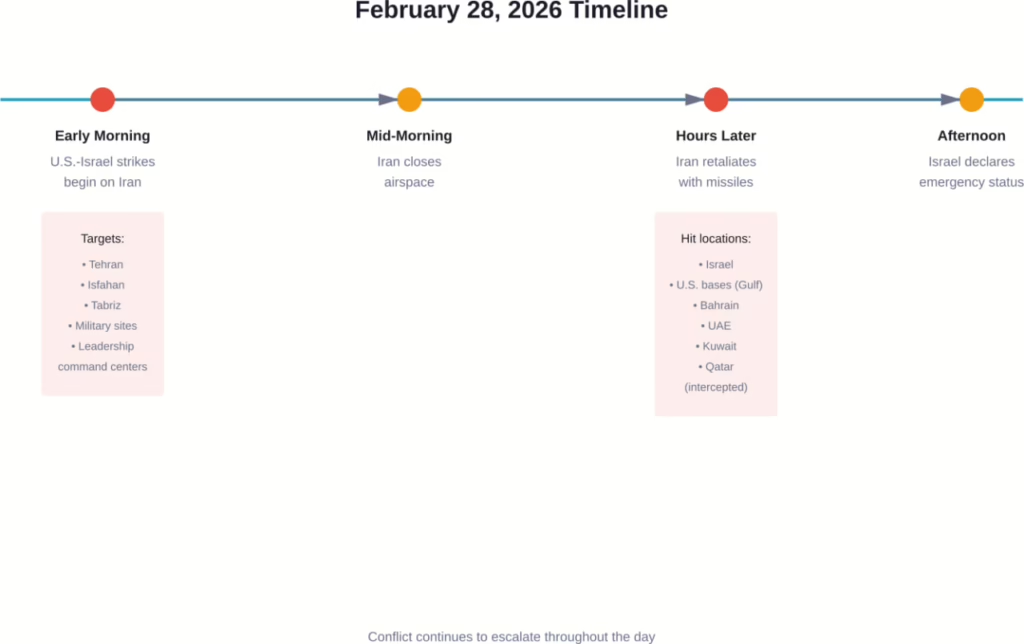
Timeline of key events on February 28, 2026, showing the sequence of strikes and retaliation
International Reactions and Diplomatic Fallout
The international community responded swiftly to the outbreak of direct military conflict between these powers.
United Nations Condemnation
According to UN News, UN Secretary-General António Guterres and the heads of UN agencies condemned both Saturday’s joint Israeli and U.S. attacks on Iran and the Iranian retaliatory strikes on Israel and the Gulf regions.
The UN statement warned that these actions “undermine international peace and security.” This represents a balanced condemnation of both the initial strikes and Iran’s response, reflecting the UN’s concern about rapidly escalating conflict.
European Union Response
The European Union urged “maximum restraint” from all parties. European officials expressed deep concern about the potential for wider regional conflagration.
Mediator Warnings
Oman, which has served as a mediator between Iran and the United States, warned the U.S. “not to get sucked in” further into the conflict. This warning carries particular weight given Oman’s role in facilitating indirect talks between the two nations earlier in February 2026.
According to UN News published on February 6, 2026, Secretary-General Guterres welcomed the resumption of talks between Iran and the United States. Those talks, held in Oman with delegations headed by U.S. Special Envoy to the Middle East Steve Witkoff and Iran’s Foreign Minister Abbas Araghchi, followed weeks of tensions surrounding Iran’s nuclear program.
Saturday’s military action effectively ends that diplomatic track, at least for now.
Background: How Did We Get Here?
The February 28 strikes didn’t happen in a vacuum. They’re the culmination of escalating tensions that have been building for months.
The December 2025-January 2026 Protests
According to the U.S. State Department, nationwide protests erupted in Iran in December 2025 and January 2026. The Iranian regime unleashed violent repression against demonstrators.
Brookings Institution described these as “the new Iranian revolution,” noting that “a battle for the future of Iran is being waged on its streets by its citizens.” The analysis, published on January 12, 2026, suggested that even if the regime survives this latest upheaval, Iran’s theocratic government is moving steadily closer to its own collapse.
An expert from UConn, visiting assistant professor Nasim Basiri, noted in a February 6 interview that “very few people understand what is happening” regarding the Iranian uprising. The protests that erupted on December 28, 2025, reflected long-simmering discontent with the regime.
Leadership Transition Questions
The Council on Foreign Relations published analysis on February 18, 2026, titled “Leadership Transition in Iran,” noting that Iran is “at the cusp of a historic transition.” At eighty-six years old, Supreme Leader Ayatollah Ali Khamenei is the Middle East’s longest-serving head of state.
The Islamic Republic has been reeling from dramatic reversals to its regional posture and nuclear program, as well as repeated public uprisings that have only been suppressed through violent mass repression.
U.S. Diplomatic Pressure
The U.S. State Department ramped up diplomatic pressure throughout February 2026:
- February 18, 2026: Announced additional visa restrictions targeting individuals involved in inhibiting Iranians’ rights to freedom of expression
- February 25, 2026: Designated individuals and entities involved in weapons procurement networks supporting Iran’s ballistic missile programs, based in Iran, Türkiye, and the United Arab Emirates
- February 27, 2026: Secretary of State Marco Rubio designated Iran as a State Sponsor of Wrongful Detention
In his statement on February 27, Rubio noted that when the Iranian regime seized power 47 years ago, Ayatollah Khomeini consolidated his control by endorsing hostage taking of U.S. embassy staff, and that for decades Iran has continued wrongful detention practices.
Nuclear Tensions
The resumption of talks in early February came after “weeks of tensions surrounding Iran’s nuclear programme and threats of a US military attack,” according to UN News.
One anonymous Trump advisor told Axios: “The boss is getting fed up. Some people around him warn against going to war with Iran, but I think there is 90% chance we see kinetic action in the next few weeks.” United States officials reportedly stated that Iran had two weeks to submit a detailed proposal.
That deadline appears to have passed without resolution, leading to Saturday’s military action.
| Date | Event | Significance |
|---|---|---|
| Dec 28, 2025 | Protests erupt in Tehran | Beginning of nationwide uprising |
| Jan 12, 2026 | Regime crackdown intensifies | Violent repression of demonstrations |
| Feb 6, 2026 | U.S.-Iran talks resume in Oman | Brief diplomatic opening |
| Feb 18, 2026 | U.S. imposes new visa restrictions | Targeting human rights abusers |
| Feb 25, 2026 | Sanctions on weapons networks | Disrupting ballistic missile programs |
| Feb 27, 2026 | Iran designated wrongful detention sponsor | Escalating diplomatic pressure |
| Feb 28, 2026 | U.S.-Israeli strikes on Iran | Direct military confrontation begins |
What’s at Stake: Regional Implications
The conflict extends far beyond U.S.-Iranian relations. The entire Middle East faces potential destabilization.
Gulf States in the Crossfire
Arab states hosting U.S. military installations find themselves directly in the line of fire. Bahrain, UAE, Kuwait, and Qatar all experienced Iranian strikes on Saturday.
These nations have walked a delicate diplomatic tightrope, maintaining relationships with both Washington and Tehran. That balancing act becomes significantly harder when missiles are flying.
Israel’s Security Calculations
For Israel, the strikes represent an attempt to eliminate what Netanyahu called “the existential threat posed by the terrorist regime in Iran.” The targeting of Iran’s supreme leader, president, and military chief suggests Israel sees this as an opportunity for decisive action.
But the special state of emergency declared after Iran’s retaliation shows Israel remains vulnerable to Iranian missiles, despite its sophisticated defense systems.
Hezbollah and Regional Proxies
Israel’s simultaneous strikes on Hezbollah positions in southern Lebanon indicate concern about Iran’s regional proxy network. Iran has long supported militant groups throughout the Middle East.
According to the Council on Foreign Relations, Iran-backed proxy forces ramped up strikes in protest of Israel’s military operations, including more than two hundred attacks on U.S. targets. The outbreak of war between Israel and Hamas in October 2023 escalated tensions between Iran and Israel significantly.
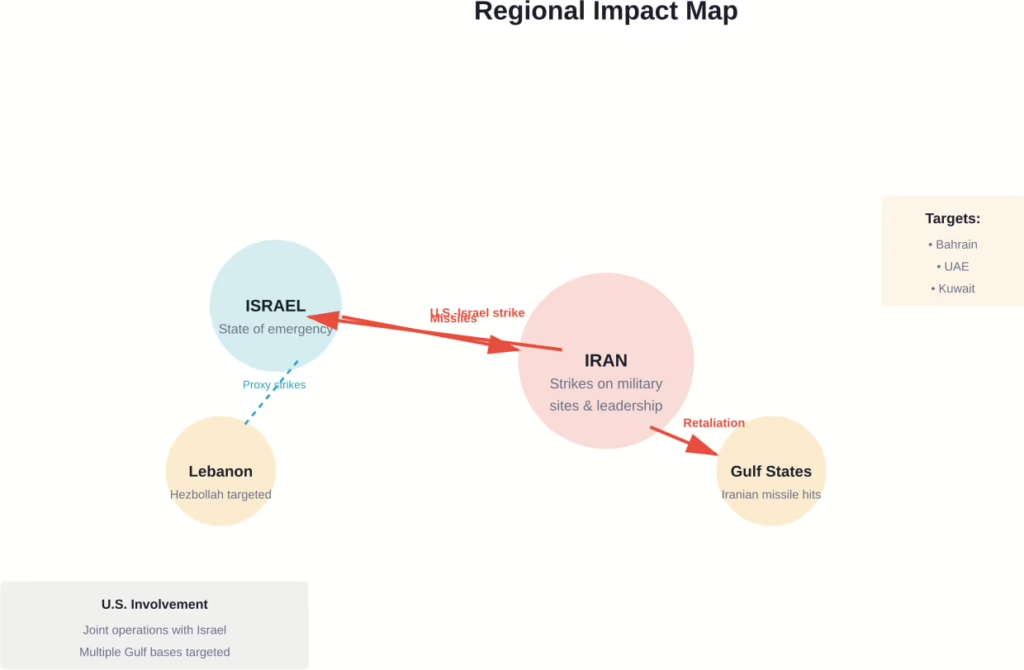
Geographic scope of February 28, 2026 conflict showing strike locations and retaliatory targets
The Domestic Situation Inside Iran
Saturday’s strikes occur against a backdrop of severe domestic instability within Iran.
Ongoing Protests and Repression
The protests that began in late December at Tehran’s Grand Bazaar in response to worsening economic conditions quickly spread to universities and other cities. Slogans evolved from economic grievances to direct challenges to the regime’s legitimacy.
Brookings Institution notes that even if the regime survives this latest upheaval, Iran’s theocratic government faces an existential crisis. The repeated need for violent mass repression to suppress public uprisings demonstrates the regime’s lack of popular legitimacy.
Economic Pressures
International sanctions have devastated Iran’s economy. According to the Council on Foreign Relations, between 2011 and 2015, international sanctions led Iran’s economy to contract by 20 percent and unemployment to rise to 20 percent.
Current economic conditions appear even worse, triggering the widespread protests. The designation of Iran’s shadow fleet and additional sanctions on February 25 further tightened economic pressure.
Leadership Vulnerability
The targeting of Ayatollah Khamenei in Saturday’s strikes represents an unprecedented escalation. At eighty-six, Khamenei’s age and health have long been subjects of speculation.
Trump’s statements regarding regime change suggest the U.S. sees an opportunity for political change amid this vulnerability. Whether ordinary Iranians, facing airstrikes from foreign powers, will embrace that message remains an open question.
What Happens Next?
The situation remains extremely fluid. Several scenarios could unfold in coming days and weeks.
Sustained Military Campaign
Sources told CNN that the U.S. is planning for several days of attacks. Trump described operations as “massive and ongoing,” suggesting this isn’t a one-off strike but the beginning of a sustained campaign.
If strikes continue and Iran continues retaliating, the risk of wider regional war increases dramatically.
Proxy Escalation
Iran’s network of regional proxies—Hezbollah in Lebanon, various militias in Iraq and Syria, Houthi forces in Yemen—could intensify attacks on U.S. and Israeli interests throughout the Middle East.
This would stretch American and Israeli military resources across multiple theaters simultaneously.
Diplomatic Off-Ramps
Despite the military action, diplomatic channels haven’t completely closed. Oman’s warning to the U.S. suggests mediators remain engaged.
The UN’s condemnation of both sides leaves room for the international community to push for de-escalation. But with Trump calling for regime change and Iran retaliating across the region, finding an off-ramp won’t be easy.
Internal Iranian Dynamics
How Iranians themselves respond matters enormously. Will foreign strikes rally citizens around the regime, or will the call for them to take action against their government resonate with a population already protesting in the streets?
Brookings scheduled an event for March 3, 2026, titled “War in Iran: What happens next?” suggesting experts anticipate ongoing developments.
| Scenario | Probability | Key Indicators |
|---|---|---|
| Sustained military campaign | High | Continued strikes over multiple days; U.S. reinforcements to region |
| Negotiated de-escalation | Medium | Mediator activity; pause in strikes; diplomatic statements softening |
| Wider regional war | Medium-High | Proxy forces engaging; additional countries drawn in; civilian casualties mounting |
| Internal Iranian collapse | Low-Medium | Mass protests resurging; military defections; leadership crisis |
Frequently Asked Questions
Why did the U.S. and Israel attack Iran on February 28, 2026?
The strikes represent the culmination of months of escalating tensions over Iran’s nuclear program, its support for militant proxies, and domestic repression. U.S. officials indicated Iran had a deadline to submit detailed proposals regarding its nuclear activities. Israeli Prime Minister Netanyahu described the operation as removing “the existential threat posed by the terrorist regime in Iran.”
What cities in Iran were targeted?
Explosions were reported in Tehran, Isfahan, and Tabriz. The strikes targeted military sites and Iranian regime leadership, including Supreme Leader Ayatollah Ali Khamenei, the president, and head of the armed forces.
How did Iran retaliate?
Iran launched missile and drone strikes against Israel and U.S. military bases across the Gulf region. Explosions were reported in Israel, Bahrain, UAE, Kuwait, and Qatar (which intercepted the missiles). Iran confirmed targeting U.S. bases throughout the Middle East.
Could this lead to a wider regional war?
The risk is significant. With Iran’s proxy forces throughout the region, multiple Arab states hosting U.S. bases under fire, and Israel on high alert, the potential for escalation is substantial. The UN Secretary-General warned that these actions “undermine international peace and security.”
What did President Trump say about the strikes?
Trump described the military campaign as “massive and ongoing” and warned American lives may be lost. He also called directly on Iranian citizens to take action against their government, explicitly advocating for regime change.
Were the strikes coordinated between the U.S. and Israel?
Yes. U.S. officials confirmed to Al Jazeera that the attacks were carried out as a joint military operation between the United States and Israel. Israeli Prime Minister Netanyahu stated that “Israel and the United States embarked on an operation” together.
What has the international community said?
The UN Secretary-General condemned both the attacks and retaliatory strikes. The European Union urged “maximum restraint.” Mediator Oman warned the U.S. “not to get sucked in” further into conflict. The international response emphasizes concern about rapid escalation.
Conclusion
February 28, 2026 marks a dangerous turning point in Middle Eastern geopolitics. The joint U.S.-Israeli strikes on Iran and Tehran’s retaliatory response represent the most direct military confrontation between these powers in decades.
With Trump calling for regime change, Iran striking back across multiple countries, and domestic protests challenging the Iranian government’s legitimacy, the situation remains highly volatile. The next days and weeks will determine whether this escalation can be contained or whether the region is headed toward a wider war.
What’s clear is that diplomatic talks that showed promise just weeks ago have given way to military action. Whether diplomacy can reassert itself before the situation spirals further out of control remains one of the most critical questions facing the international community.
Stay informed as this situation continues to develop. The stakes for regional stability, global oil markets, and international security couldn’t be higher.