
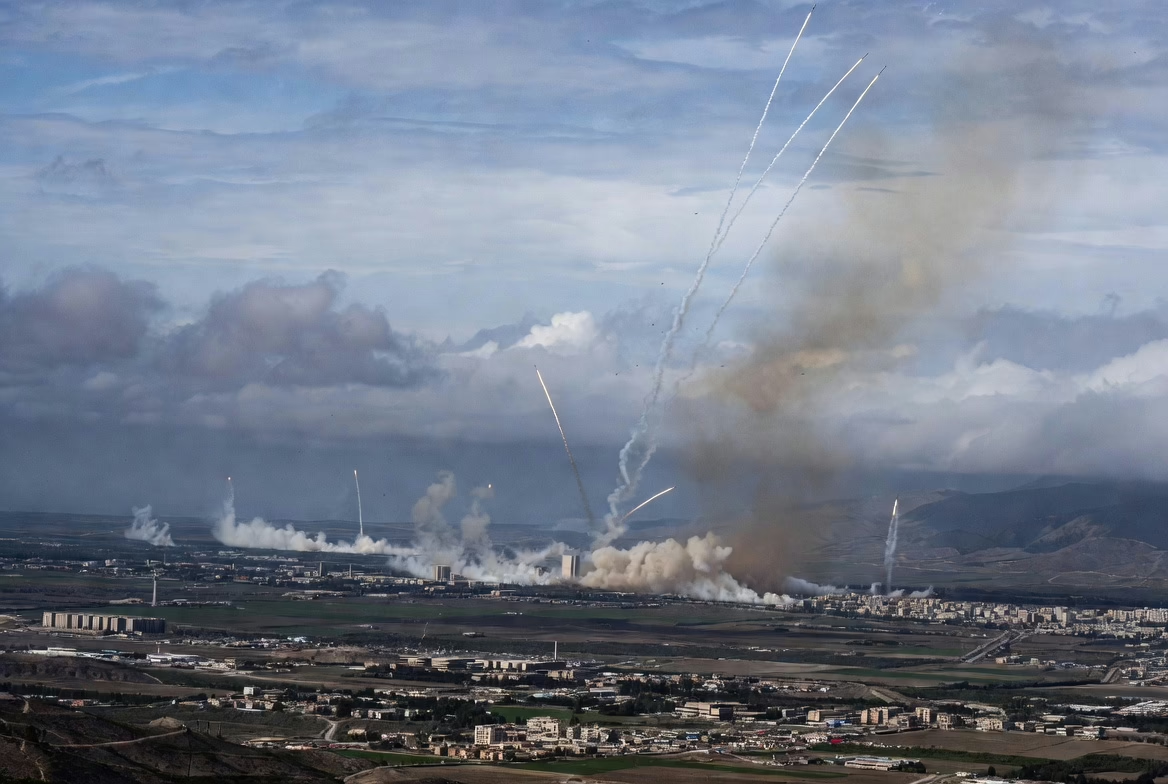
Executive Summary: On February 28, 2026, the United States and Israel launched coordinated military strikes against Iran targeting nuclear facilities, military infrastructure, and leadership sites. The operation represents the most significant military escalation between these nations in decades, following months of diplomatic tensions. Iran retaliated with missile strikes, triggering concerns about regional stability, global oil markets, and potential broader conflict.
The morning of February 28, 2026 marked a turning point in Middle Eastern geopolitics. Coordinated strikes by United States and Israeli forces hit targets across Iran, from Tehran to provincial military installations. The operation came after months of escalating threats and failed diplomatic negotiations.
What started as diplomatic pressure transformed into active military engagement. The consequences ripple far beyond the immediate combat zone, affecting global energy markets, regional alliances, and international security frameworks.
Here’s what actually happened—and what it means for the region and the world.
The Events Leading to February 28, 2026
The path to military confrontation didn’t materialize overnight. According to the United States Department of State, sanctions targeting Iran’s weapons procurement networks and shadow fleet were announced on February 25, 2026. These measures aimed to disrupt Iran’s ballistic missile programs and cut off revenue streams from illicit oil sales.
Secretary of State Marco Rubio designated Iran as a State Sponsor of Wrongful Detention on February 27, 2026, citing the 1979 embassy seizure and decades of detaining citizens as political leverage. The statement noted that “for decades, Iran has continued to cruelly exploit detainees as bargaining chips.”
But the diplomatic track wasn’t completely dead. According to UN Secretary-General António Guterres, as reported in the February 27, 2026 noon briefing, indirect talks between Iran and the United States were continuing even as military assets deployed to the region.
The military buildup was impossible to ignore. Analysis from ACLED indicates the current US military deployment around Iran includes multiple carrier strike groups, long-range strike aircraft, air defenses, and extensive logistics capacity—estimated at roughly 40-50% of deployable US naval and air assets in theater.
That’s not symbolic posturing. That’s preparation for major combat operations.
The Diplomatic Breakdown
Anonymous Trump administration officials told Axios there was a “90% chance we see kinetic action in the next few weeks,” adding that “the boss is getting fed up.” United States officials reportedly gave Iran two weeks to submit a detailed proposal for negotiations.
That deadline apparently expired without satisfactory Iranian response. The strikes followed.
Operation Epic Fury: What Actually Happened
The coordinated assault began in the early morning hours of February 28, 2026. Israeli forces launched what Prime Minister Benjamin Netanyahu described as “preemptive” strikes, followed by US military operations that President Donald Trump characterized as “major combat operations.”
Netanyahu’s statement was unequivocal: “For 47 years, the Ayatollah regime has called out ‘Death to Israel’ and ‘Death to America’.” He described the Iranian government as a “murderous terror regime” that “must not be allowed to arm itself with nuclear weapons.”
The strikes hit multiple target categories across Iran. Some of the first attacks appeared to focus on areas around Supreme Leader Ayatollah Ali Khamenei’s offices in Tehran, with Iranian media reporting strikes nationwide and smoke visible rising from the capital.
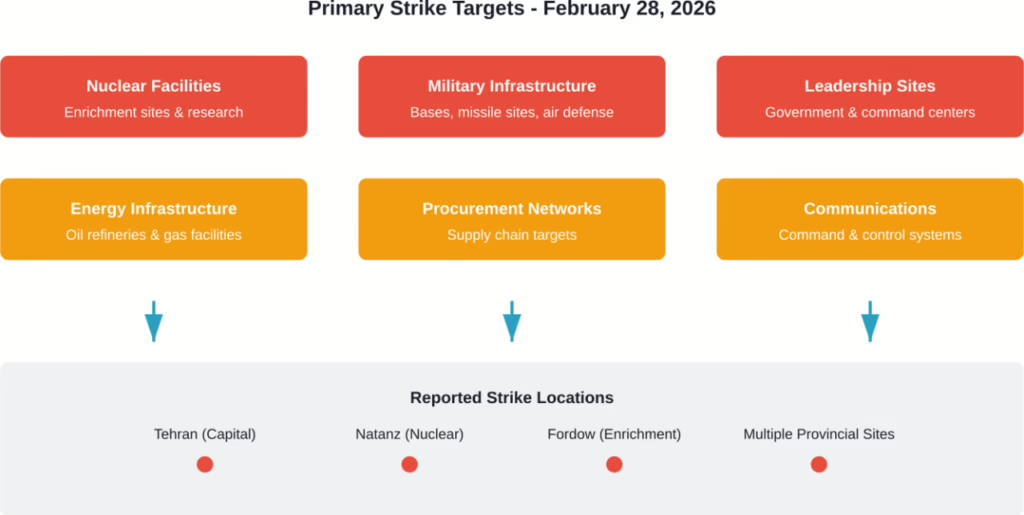
Breakdown of strike targets during Operation Epic Fury on February 28, 2026, showing priority targeting of nuclear, military, and leadership infrastructure.
Brookings Institution analysis noted that Israel’s military strikes initially focused on Iran’s nuclear program, but later expanded to include energy infrastructure. On June 14 during the previous 2025 conflict, they included an oil refinery and production and processing facilities for South Pars, the world’s largest natural gas field. The global benchmark Brent Crude oil price jumped 7% on June 13, the day strikes began.
It wasn’t immediately clear whether the 86-year-old Supreme Leader was in his offices during the February 28 strikes. But targeting leadership compounds sends an unmistakable message about regime change objectives.
Iran’s Retaliation
Tehran didn’t wait long to respond. Iranian forces launched missile strikes targeting Israeli positions and multiple US military bases across the region. The scale and coordination suggested pre-planned contingency operations rather than improvised responses.
Details regarding civilian casualties were not immediately available, according to UN statements. The fog of war makes accurate assessments difficult in the immediate aftermath.
Economic Consequences: Oil Markets and Global Trade
The strikes sent shockwaves through global energy markets. And that shouldn’t surprise anyone—roughly 20% of the world’s supply of both oil and liquified natural gas travels through the Strait of Hormuz, according to Brookings energy policy experts.
That narrow waterway sits squarely within Iranian territorial waters and missile range. It’s Iran’s “ace in the hole,” as Brookings described it—the ultimate leverage point against Western economic interests.
During the June 2025 Israel-Iran conflict, Brent Crude oil prices jumped 7% in a single day when strikes included energy infrastructure. Brent Crude oil price jumped 7% on June 13, the day after strikes began, and a further 0.5% on the morning of June 16.
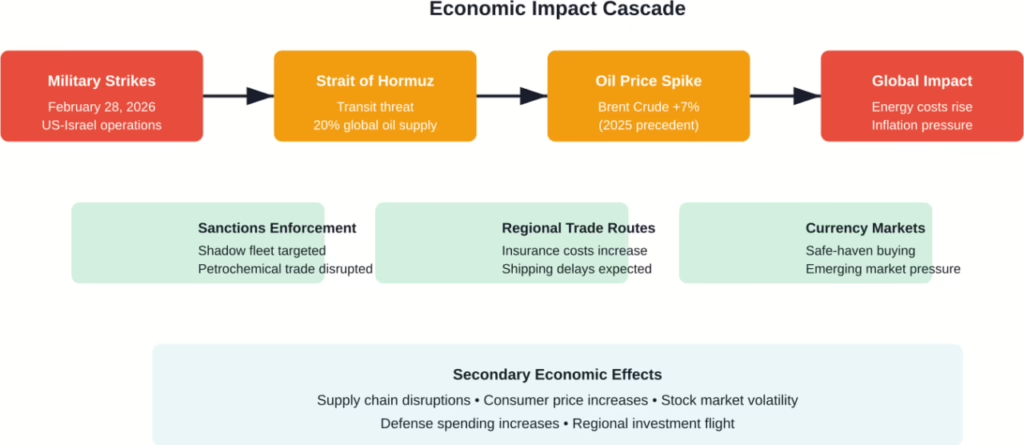
The cascading economic consequences of the February 28 military actions, from immediate market reactions to broader systemic effects.
Sanctions Compound Economic Pressure
The State Department’s February 6, 2026 sanctions specifically targeted illicit oil traders and Iran’s shadow fleet. These measures aimed to “stem the flow of revenue that the regime in Tehran uses to support terrorism abroad and repress its citizens.”
One Turkish company, DIAKO IC VE DIS TICARET ANONIM SIRKETI, imported over $700,000 worth of Iranian-origin petrochemical products between January 2024 and August 2024, according to State Department sanctions notices. That’s the kind of intermediate trader getting squeezed by the sanctions regime.
When sanctions meet military action, the economic consequences multiply. Iran can’t easily sell oil when buyers face US penalties. And buyers can’t safely transport oil through threatened shipping lanes.
The economic vise tightens from both directions.
Regional Security and International Reactions
The February 28 strikes didn’t happen in a vacuum. They occurred against the backdrop of ongoing regional conflicts, proxy warfare, and complicated alliance structures throughout the Middle East.
According to Brookings documentation, there are some concerning parallels to the June 2025 Israel-Iran conflict. That confrontation ended in what experts described as a “fragile ceasefire that did not resolve underlying disputes between Tehran, Washington, and Tel Aviv.”
Sound familiar? Temporary de-escalation without addressing root causes tends to produce recurring crises.
What the UN Says
UN Secretary-General António Guterres has consistently called for diplomatic solutions. In the February 27, 2026 briefing—one day before the strikes—his spokesman welcomed “the continuation of indirect talks between the Islamic Republic of Iran and the United States.”
That diplomatic window apparently closed fast. The UN’s position emphasizes de-escalation and dialogue, but international organizations have limited enforcement mechanisms when major powers decide on military action.
The Secretary-General’s statements typically express concern, call for restraint, and urge return to negotiation. Those appeals carry moral weight but limited practical impact once missiles start flying.
Allied Responses and Regional Positioning
Regional allies face difficult calculations. Gulf Arab states want Iranian influence contained but don’t necessarily welcome major military conflict on their doorstep. They host US military bases that become targets when Iran retaliates.
Turkey maintains complex relationships with both Western allies and Iran. The State Department’s sanctions targeting Turkish petrochemical traders highlights these tensions—Ankara walks a tightrope between NATO membership and economic relationships with Tehran.
European allies generally support pressure on Iran’s nuclear program but express reservations about military approaches. That creates friction within Western alliances about strategy and tactics.
| Actor | Primary Interest | Stance on Military Action | Key Concerns |
|---|---|---|---|
| United States | Prevent nuclear weapons capability | Direct military engagement | Regional stability, allied security |
| Israel | Eliminate existential threat | Coordinated strikes | Iranian retaliation, proxy forces |
| Iran | Regime survival, regional influence | Defensive retaliation | Economic collapse, internal unrest |
| Gulf Arab States | Contain Iranian expansion | Supportive but cautious | Retaliation against their territory |
| European Union | Nuclear non-proliferation | Prefer diplomatic solutions | Energy security, refugee flows |
| Russia | Maintain influence, arms sales | Oppose US-led action | Regional power balance |
| China | Energy access, trade routes | Oppose US-led action | Economic disruption, precedent |
Nuclear Program Implications
The nuclear dimension separates this conflict from typical regional disputes. Iran’s uranium enrichment program has been the central Western concern for years.
According to Brookings testimony from 2023, “Tehran has not yet taken the most drastic steps available, such as disavowing its adherence to the NPT or curtailing all cooperation with the IAEA.” There were even “hopeful signs of Iranian restraint, including recent IAEA reports of a deceleration in the accumulation of uranium enriched to 60%.”
But wait. That was 2023. By July 2025, according to Brookings timeline documentation, Iran had declared its breach of the 300-kilogram, 3.67% enriched uranium stockpile limit outlined by the JCPOA.
The trajectory pointed toward weapons capability. That’s what prompted the military response.
Assessing Strike Effectiveness
Here’s the thing though—determining whether strikes actually set back Iran’s nuclear program is notoriously difficult. Brookings expert Mara Karlin, former U.S. Assistant Secretary of Defense for Strategy, Plans, and Capabilities, noted that assessing impact requires intelligence about facilities, dispersed programs, and Iran’s reconstruction capabilities.
Some nuclear infrastructure sits underground in hardened facilities designed to withstand attack. Enrichment knowledge can’t be bombed away—the scientific expertise remains even if specific facilities get destroyed.
Military strikes buy time at best. They don’t permanently eliminate nuclear capabilities unless followed by sustained diplomatic, economic, and security frameworks.
Humanitarian Concerns and Civilian Impact
Military operations inevitably affect civilian populations, even when strikes target military and government infrastructure. The humanitarian dimension often gets overshadowed by strategic discussions but matters enormously for long-term consequences.
According to UN humanitarian briefings, funding for regional humanitarian operations remains critically low. For humanitarian operations more broadly, agencies received only 11% ($181 million) of the $1.7 billion needed for 2026 humanitarian response, according to the February 27 UN briefing.
That funding shortage existed before the February 28 strikes. New humanitarian needs from US-Iran conflict will compete for the same limited resources.
The Internal Iranian Situation
Professor Nader Habibi from Brandeis University noted in June 2025 analysis that Iran’s economy already faced severe strains from sanctions before military strikes. The combination of economic pressure and military action creates compound stress on Iranian society.
The State Department designated Iran as a State Sponsor of Wrongful Detention on February 27, 2026, highlighting the regime’s use of detainees “as bargaining chips.” That designation came amid broader concerns about internal repression and human rights.
Military conflict typically strengthens authoritarian regimes in the short term—nationalist sentiment rallies around governments facing external threats. But economic devastation from prolonged conflict can eventually undermine regime stability.
What Happens Next: Possible Scenarios
The situation remains fluid and unpredictable. Several potential paths forward exist, each with different probability and consequences.
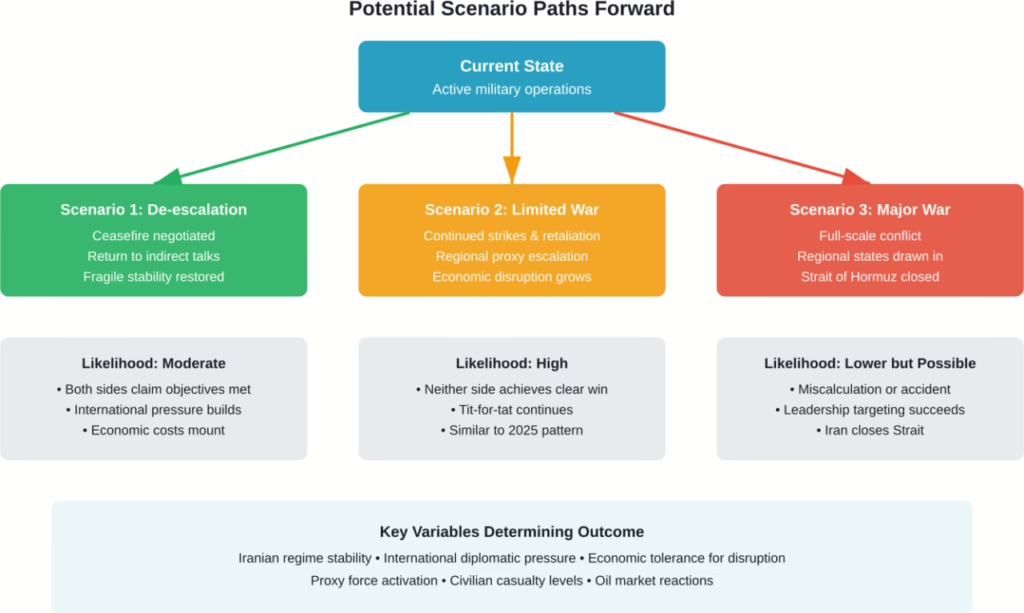
Three potential paths forward from the February 28 military actions, with likelihood assessments based on historical patterns and current dynamics.
The Limited War Scenario
Based on 2025 precedent, a limited war scenario appears most likely. This involves continued strikes and counter-strikes without full-scale invasion or comprehensive escalation. Both sides demonstrate resolve, inflict damage, but eventually exhaust themselves into another fragile ceasefire.
This pattern occurred in June 2025, according to Brookings documentation. After initial strikes and retaliation, “it appears after a little bit more back and forth, all three countries have agreed to a ceasefire. It seems a little bit tenuous, but it appears to be holding for the moment.”
Tenuous ceasefires don’t resolve underlying conflicts. They postpone them.
Escalation Risks
The question isn’t whether escalation is possible—it’s what triggers it. Several flashpoints could transform limited conflict into something larger:
- High-profile casualties, particularly civilian deaths or leadership figures
- Closure or attempted closure of the Strait of Hormuz
- Iranian activation of proxy forces across multiple theaters
- Attacks on Gulf Arab state infrastructure or US bases causing mass casualties
- Accidental escalation from misidentified targets or communication failures
Any of these could shift calculations and push conflict into broader war.
Long-Term Strategic Implications
Beyond immediate military and economic consequences, the February 28 actions reshape Middle Eastern strategic dynamics for years to come.
The precedent of direct US-Israeli military operations against Iranian state infrastructure marks a threshold crossing. Previous conflicts operated through proxies, cyber operations, or limited strikes. Coordinated attacks on nuclear facilities, leadership sites, and military infrastructure across Iranian territory represent a different magnitude.
That precedent won’t be easily contained. Other regional actors observe how conflicts develop, what international responses emerge, and which strategies prove effective.
Nuclear Non-Proliferation Framework
The strikes raise fundamental questions about nuclear non-proliferation enforcement. Military action without UN Security Council authorization—impossible given Russian and Chinese vetoes—creates a model of unilateral enforcement outside international legal frameworks.
That approach achieves short-term objectives but undermines long-term non-proliferation architecture. Other states facing proliferation threats may cite this precedent for their own military action.
The erosion of international institutional authority has consequences that extend beyond Iran.
Alliance Structures and Trust
Regional states hosting US military bases now face demonstrated risk of becoming retaliation targets. That affects future basing agreements, access rights, and military cooperation.
European allies preferring diplomatic approaches find themselves presented with military faits accomplis. That strains transatlantic coordination and raises questions about consultation processes within alliances.
These alliance management challenges don’t disappear when the immediate crisis ends.
Frequently Asked Questions
What prompted the February 28, 2026 strikes against Iran?
The strikes resulted from months of escalating tensions over Iran’s nuclear program, failed diplomatic negotiations, and Iranian breaches of uranium enrichment limits. The US designated Iran as a State Sponsor of Wrongful Detention on February 27, and imposed sanctions on weapons procurement networks on February 25. President Trump’s administration reportedly gave Iran a two-week ultimatum that expired without satisfactory response, leading to coordinated US-Israeli military action.
How did Iran retaliate to the strikes?
Iran launched missile strikes targeting Israeli positions and multiple US military bases across the region. The retaliation appeared coordinated and pre-planned, suggesting contingency operations rather than improvised responses. Specific casualty figures and damage assessments were not immediately available in the conflict’s early hours.
What are the oil market consequences?
The strikes threaten global energy supplies because approximately 20% of the world’s supply of both oil and liquified natural gas transits through the Strait of Hormuz, which Iran can potentially disrupt. During the June 2025 Israel-Iran conflict, Brent Crude oil prices jumped 7% in one day when strikes hit energy infrastructure. Similar or greater price volatility is expected from the February 28 operations.
Will this lead to a broader Middle East war?
The situation remains unpredictable. Based on 2025 precedent, a limited war scenario with continued strikes and counter-strikes appears most likely, eventually leading to another fragile ceasefire. However, escalation risks remain significant, particularly if the Strait of Hormuz closes, high-profile casualties occur, or regional proxy forces activate across multiple theaters.
What happened to diplomatic efforts?
According to UN Secretary-General statements from February 27, indirect talks between Iran and the United States were continuing even as military assets deployed. Those diplomatic channels apparently failed to produce agreement before the military deadline. The UN continues calling for de-escalation and return to negotiations, but has limited enforcement mechanisms once major powers decide on military action.
How effective were strikes against Iran’s nuclear program?
Assessing effectiveness is difficult and requires intelligence about facility damage, program dispersal, and Iran’s reconstruction capabilities. Some nuclear infrastructure sits in hardened underground facilities designed to withstand attack. Military strikes may delay but don’t permanently eliminate nuclear capabilities unless followed by sustained diplomatic, economic, and security frameworks. The strikes likely buy time rather than provide permanent solutions.
What are the humanitarian consequences?
Civilian impact details were not immediately available following the February 28 strikes. Humanitarian funding for regional operations was already critically low before the conflict—Sudan received only 11% of needed funding according to UN briefings. New humanitarian needs from US-Iran conflict will compete for limited resources. Iran’s economy already faced severe sanctions pressure before military strikes, creating compound stress on Iranian society.
Conclusion: Uncertain Path Ahead
The February 28, 2026 military actions between the United States, Israel, and Iran mark a significant escalation in a decades-long confrontation. The coordinated strikes targeted Iran’s nuclear facilities, military infrastructure, and leadership sites—crossing thresholds that previous conflicts avoided.
The immediate consequences are clear: military casualties, infrastructure damage, regional instability, and global economic disruption. Oil markets react to threats against the Strait of Hormuz. Regional allies recalculate security arrangements. International institutions issue statements with limited practical effect.
But the long-term implications remain uncertain. Will this operation achieve its stated objectives of preventing Iranian nuclear weapons capability? Will Iran’s retaliation remain proportional or escalate into broader conflict? Can diplomatic channels reopen after military engagement, or does the violence foreclose negotiated solutions?
History suggests limited military actions rarely produce decisive outcomes against determined adversaries. The June 2025 conflict followed a similar pattern—strikes, retaliation, fragile ceasefire, unresolved underlying disputes. That precedent offers a roadmap but not a guarantee.
What’s certain is that the Middle East strategic landscape shifted on February 28, 2026. The consequences—military, economic, diplomatic, and humanitarian—will unfold over months and years. The fog of war obscures immediate clarity, but the trajectory points toward prolonged instability rather than quick resolution.
Stay informed about developments as this crisis evolves. The situation remains fluid, with potential for both de-escalation and further conflict. Understanding the complex dynamics at play helps make sense of an uncertain and dangerous moment in international relations.